Long before a seed recommendation is made, Stine® Seed Company sales representatives are in the field, walking plots and seeing how varieties perform under real growing conditions so that, when the time comes, they can give growers the most accurate, research-backed advice available.
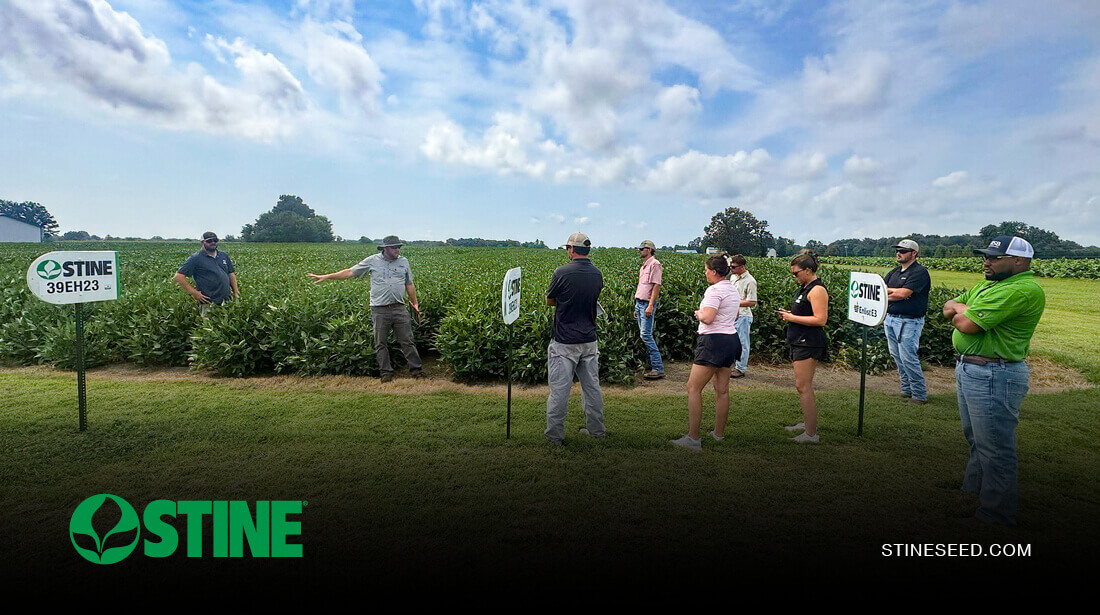
Stine’s agronomy and retail development teams put that into practice this summer when they conducted in-field plot trainings for some of our dealer partners across the country.
Each training session focuses on the agronomic challenges hitting hardest in their region and how Stine products are standing up to the test. The information shared equips dealers to walk into any grower conversation prepared to show the true value of Stine corn and soybean products, along with our competitive lineup of seed treatments.
"Putting our retail specialists alongside Stine’s agronomy team in the same plots changes the quality of every conversation they’ll have going forward," says Jeff Anderson, national director of retail development. “When a dealer can point to a field edge and explain what gall midge damage actually looks like or walk a grower through why one soybean line outperforms another in high-pH soil, that’s not a sales pitch — that’s trusted advice.”
Training where the pressure is highest
Some of the areas where we've held these trainings have given us a firsthand look at real-world field stressors, including western Iowa, which has seen significant soybean gall midge pressure in recent years. The soils across this corridor have also presented real iron deficiency chlorosis (IDC) challenges for growers. Taking the training to these locations meant dealers could see the same conditions their customers are dealing with, not a controlled environment but the real thing.
Stine’s agronomy and retail development teams work closely together throughout the year to keep our dealer network informed with current, accurate information through field days, plot visits and direct agronomic support. In-field training is one of the most direct ways to share agronomic knowledge because dealers can compare variety and hybrid performance side by side, ask questions in context, and connect what they’re seeing to conversations they’re already having with growers.
Soybean gall midge
Soybean gall midge has become one of the most significant agronomic concerns in Iowa and neighboring states, and western Iowa has been among the hardest-hit areas. The pest was first confirmed as a new species in 2019 and has since expanded across Nebraska, Iowa, Minnesota, Kansas, Missouri, South Dakota and North Dakota.
Adults fly in late spring and lay eggs on young soybean stems. The larvae feed on inner stem tissue, cutting off the plant’s ability to move water and nutrients. Damage typically concentrates along field edges and can be mistaken for compaction or herbicide drift until the stem is split and larvae are found inside.
Once the active management window passes each year, scouting becomes the most valuable tool available. Growers who walk their field edges and document where damage occurred are building the information they’ll need to make smarter variety placement decisions the following season. They can also check the Soybean Gall Midge Alert Network to see whether the pest has been reported in their area. Knowing which fields saw pressure, how severe it was and how different varieties responded gives dealers specific, useful information as fall sales conversations begin.
Stine’s agronomy team has been actively expanding its gall midge research. In 2025, Stine agronomists tested 33 of our soybean lines near Avoca, Iowa, one of the areas with the heaviest gall midge pressure in the region. That work continues in direct partnership with the University of Nebraska–Lincoln Institute of Agriculture and Natural Resources, with both teams sharing field data and analysis to evaluate how commercially available soybean genetics respond to real-world gall midge pressure.
For more on Stine’s gall midge research efforts, visit our blog article: “Stine® agronomy expands research efforts to address soybean gall midge.”
IDC tolerance in soybeans
IDC is a persistent challenge across much of the Corn Belt, particularly in high-pH soils where iron availability drops. Cool, wet conditions, common in western Iowa, make the problem worse by limiting the plant’s ability to absorb soluble iron, leading to interveinal chlorosis on newly developing leaves and, in severe cases, stunted plants and yield loss.
The practical value of the training for IDC comes down to placement. Which soybean lines hold up in IDC-prone soils? How do you match a line to a field with a known history of pressure? Those are the conversations dealers are having with growers as planning for the next season begins, and the plot data gives them something concrete to work with.
Stine’s agronomy team uses drone technology and field imaging each season to evaluate IDC performance across our soybean lineup, generating variety-level data that helps dealers move beyond general guidance and into specific field-by-field recommendations.
Growers who noted IDC symptoms during the season should document those fields and work with their Stine rep to identify soybean lines with strong IDC tolerance for the following year. Learn more about Stine’s IDC research and how to scout for it: “2026 crop watch: Stay ahead of SDS and IDC in soybeans.” For variety-level agronomic information, visit our soybean agronomics page.
Seed treatment performance
Seed decisions for the following year start to take shape well before planting. As the season progresses, growers can see where disease pressure hit, which areas underperformed and what problems showed up early. That information is exactly what should drive seed treatment selection going forward.
Part of the dealer training covered how to help growers connect what they observed throughout the season to the right seed treatment package for the year ahead. Stine XP® soybean seed treatments offer custom-blend formulations that protect against a broad spectrum of fungal pathogens and insects from the moment the seed goes in the ground. Understanding the differences between treatment options, what each is designed to address and which situations call for enhanced protection gives dealers a sharper set of tools for every sales conversation.
Agronomy and retail, working side by side
Stine’s retail development team typically coordinates these training sessions directly with the dealers, while Stine agronomists lead the plot discussions, putting agronomy and retail in the same field at the same time. That structure is intentional. A dealer who has walked a gall midge-damaged field edge, compared IDC performance between soybean lines and talked through seed treatment options with an agronomist carries that knowledge directly into conversations with growers. That’s a different level of preparation than a product sheet.
What makes these sessions effective is the format itself: dealers from across the country, in locations that directly impact their regions, with agronomists available to answer questions in real time in the same conditions growers are managing. The goal isn’t just product knowledge; it’s agronomic confidence, so the advice reaching growers is grounded in what’s actually happening in fields like theirs. That’s what great customer support looks like before the seed goes in the ground.
Ready to start the conversation on Stine seed options for 2027? Find your local Stine representative for the latest research results and product recommendations.